
How can technology support neurodivergent people to navigate the messy, unspoken and uncertain nature of social interactions?
Methods:
Surveys
Content / Interaction Analysis
Literature Review
Personas
Impact:
1. Presented design strategies to support cognitively diverse users to 100+ researchers at CHI’25.
2. Identified design opportunities for technologies to adapt to everyday social behaviors, like masking.
3. 30% of participants gained more clarity on their masking, turning subtle habits into empowered understanding.
My Role:
Lead Researcher
Project Manager
Collaborators:
2 Subject Matter Experts
6 Research Assistants
Research:
Foundational
Mixed-methods
Problem Context
Neurodivergent people often adapt how they speak, move, or express emotions to navigate ambiguous social situations, a practice known as masking.
These behaviors are often subtle to others and to self, and subject to personal communication and social circumstances. This work explored: How might we design for social adaptive behaviors like masking?
* Neurodivergent: People who process information, world in different ways. E.g., those with ADHD, Autism, Dyslexia, Dyscalculia, Bipolar neurotypes.
We’re talking about ~1.2 billion people here 🙂
Research Approach: What methods I chose and why?
I crafted a research plan that would:
- Capture subjective and varied experiences of masking behaviors.
- Minimize social desirability bias: asking people about masking while they were masking could produce filtered answers.
- Respect people’s autonomy in the research process.
- Use the research process as a driver for impact in people’s lives (i.e., Action Research).
Methods
- Surveys: Mix of multiple-choice and open text questions. Designed to give participants time and space to reflect privately, reducing on-the-spot social pressure.
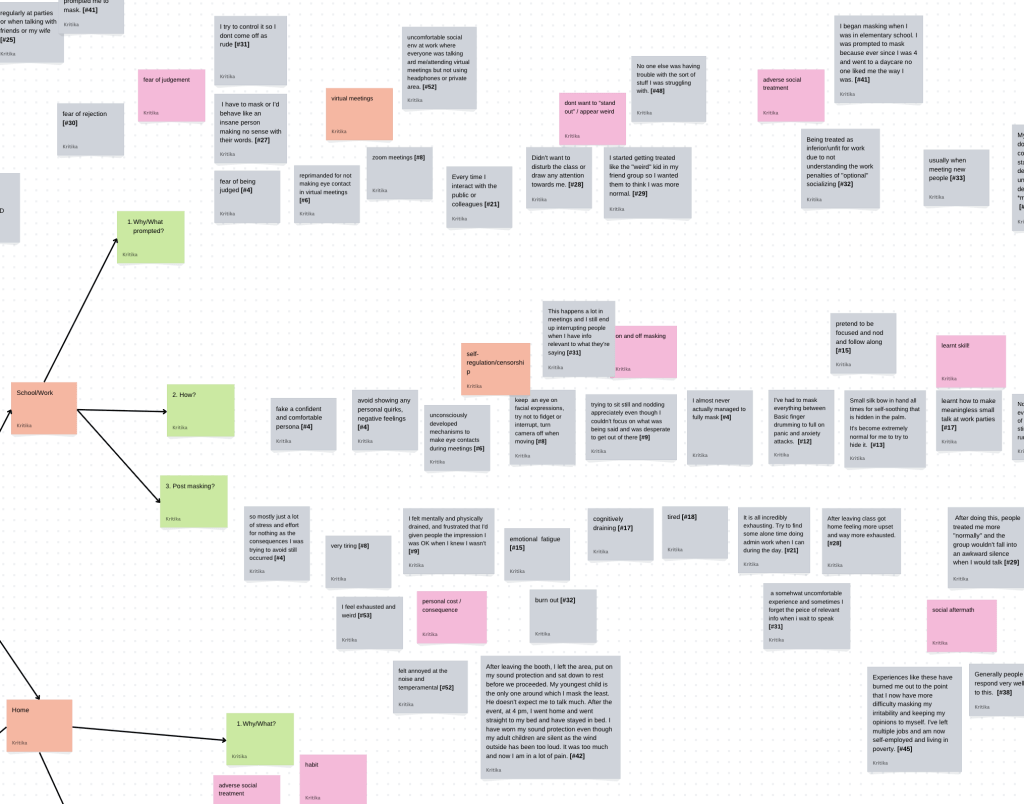
- Content & Interaction Analysis: Studied natural conversations in neurodivergent communities (on TikTok, Reddit, Twitter) to identify patterns and lived realities of masking behaviors.
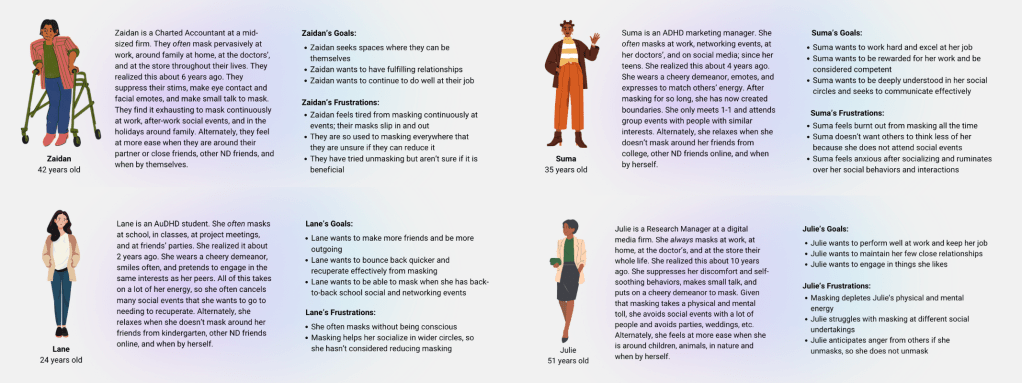
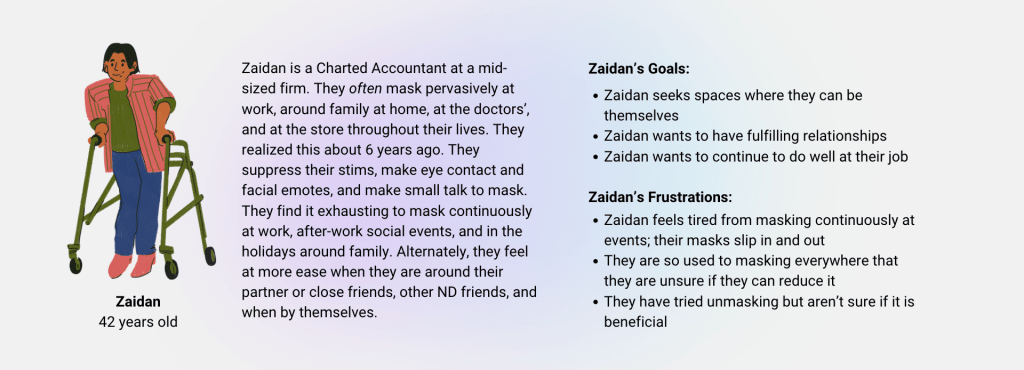
- Personas: Synthesized diverse masking motivations, needs, and strategies into actionable design references.
- Literature Review: Mapped existing knowledge on masking and technologies for neurodivergent people.
- Descriptive Analysis: Quantified demographic patterns, masking frequency, and patterns to provide a data-backed holistic view alongside qualitative findings.
Tending to the methods
I avoided interviews to minimize social desirability bias, and avoid putting people on the spot. Surveys encouraged deeper, self-paced reflection; questions were intentionally designed and ordered according to significance and balancing with participants’ cognitive load. Descriptive analysis ensured we could pair our qualitative findings with concrete demographic and behavioral trends.
Adaptations Along the Way
Soon after the survey was live, I realized that while I did have the location demographic info, racial identity was missed in data collection. This was important to piece it together with cultural, gender-based identities. So the study was expanded to include analysis of neurodivergent (especially BIPOC) community conversations and interactions.
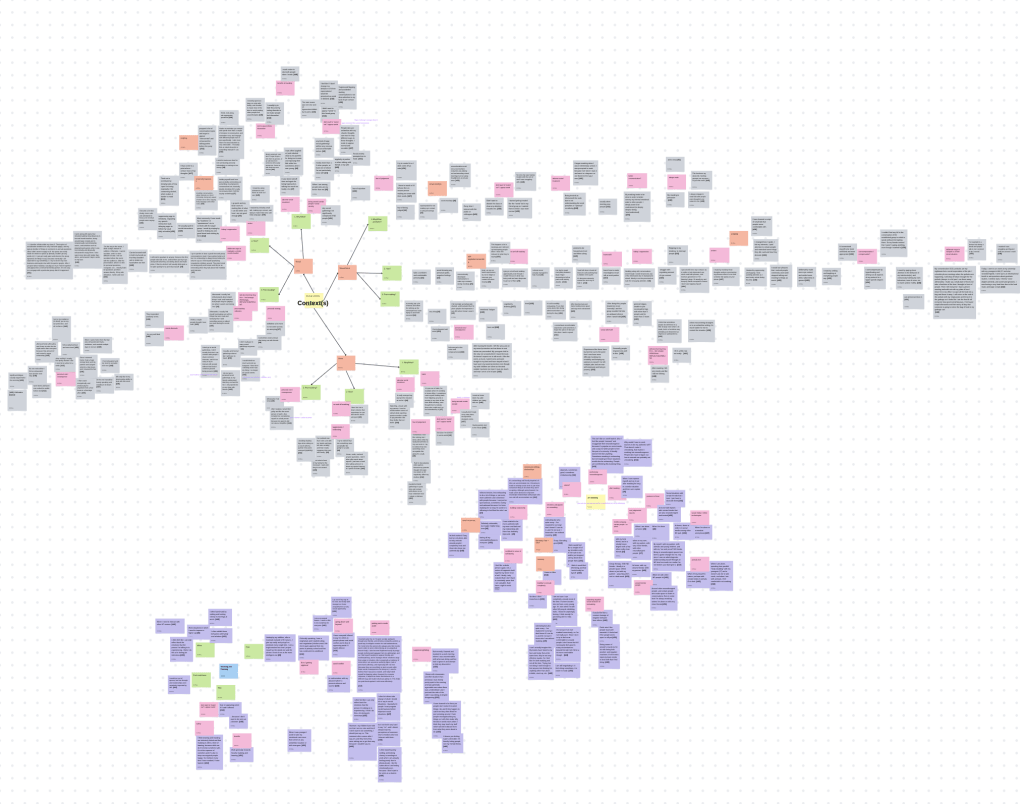
Piecing it All Together: Personas and Thematic Analysis
What we learned
Findings absolutely flipped the script on masking, turning assumptions upside down.
- Expectation v/s Reality
- We anticipated hearing about people not wanting to mask and explore other options.
- 🔄 Landed at a 180° turn: People did not want to stop, but wanted be strategic about masking.
- Understanding what masking really is
- Masking wasn’t just hiding traits, it was a spectrum of adaptive behaviors.
- ♨ Tea came in hot: People tailored how they mask across social situations.
- Motivation, Not Misrepresentation
- Masking helped people navigate stigma and ambiguity, not “fake” their identity.
- 🌊 Change in tide: Masking was infact, redirecting of energy into managing emotions, behavior and body language.
- Underneath it all: Neurodivergent people masked to navigate ambiguity in social interactions a form of emotional and cognitive labor.
- ⁉️ This raised the question : Can technology help offload that effort?
Design Strategy: Designing With Masking, Not Against It
- Reframe the “problem“: Don’t try to eliminate masking, design with it. Understand it as context, instead of an obstacle.
- Design for choice, not correction: Design tools that respond to people’s social adaptations, not override them.
- Design with burnout in mind: Build tools that support pacing, manage overwhelm, and conserve energy. Tools that share the emotional and cognitive load with socializing.
- Embrace ambiguity: Help decision-making in messy, unclear social dynamics.
Outcomes
- Advocated for neurodivergent needs in design: Brought attention to masking, a common yet nuanced neurodivergent behavior, as central to inclusive tech design.
- Brought impact back to community: 30% of survey respondents reflected feeling more clarity about their own masking—behaviors many had been doing unconsciously. This self-awareness helped them better understand and assert their social needs.
“Answering the questions in this survey helped me internally clarify some things even more 🙂 ”
- Delivered grounded strategies for neurodivergent user research: Presented research and design approaches at CHI’25 to 100+ HCI practitioners.
 Kritika